Mark Bain, President of Upper 90 Consulting, has compared the Harris Interactive’s Reputation Quotient (RQ) rankings with the Reputation Institute’s U.S. RepTrak results.
Although the two studies take different approaches, both generally agree on the worst and best corporate reputations in the US.
Mark has made a nice summary of interesting thoughts: "Rankings matter to the most reputable companies, which care about how they compare with all firms, not just their direct competitors. These companies work to improve their reputation rankings every year. Their CEOs view corporate reputation as an asset to be leveraged for strategic opportunity, not just a risk to be managed for minimal business harm. It’s no wonder these firms enjoy strong competitive advantage and consistent, sustained financial success.
Companies with the lowest reputation rankings seem to emphasize financial performance over all else, including reputation. Though most have strong financial results (none more than ExxonMobil), reputation is more of a risk than opportunity for this group. In a written response published in the Wall Street Journal, Halliburton’s spokesperson basically said her firm doesn’t care about public opinion represented in these rankings because her company doesn’t sell to consumers. But one has to wonder: would her management still feel that way when top-notch talent chooses to work with Halliburton’s more reputable competitors? Or when some government refuses to give Halliburton the benefit of the doubt in their next self-inflicted crisis, resulting in excessive regulations and/or fines?
There are B2B and B2C companies in both rankings and virtually all are highly visible. These firms work hard to build awareness, familiarity and understanding. They use the full arsenal of communications tools to tell their story proactively, and they reap the benefits of their visibility. Meanwhile, low-visibility companies can only congratulate themselves for saving money on such frivolities while their reputation languishes.
Not every company is large enough or familiar enough to be included in these rankings. But any company can use the exact same models, tools and techniques the reputation leaders use – and those that do will benefit the most."
Have a look at the rankings (source: Wall Street Journal)
read more about the subject here
Showing posts with label Reputation Quotient. Show all posts
Showing posts with label Reputation Quotient. Show all posts
Tuesday, 27 February 2007

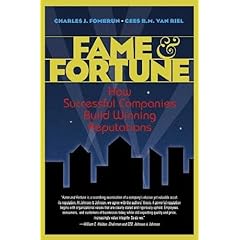
Fame & Fortune by Charles Fombrun and Cees Van Riel
In Fame & Fortune: How Successful Companies Build Winning Reputations, Charles Fombrun and Cees Van Riel explain corporate reputation in simple and clear terms. The book serves as a guide for quickly applying the concepts of reputation.
 The book provides a comprehensive overview of the critical success factors of reputation management and discusses a number of interesting case studies to underline key points. It shows how to quantitatively measure a company's reputation, estimate its business value, and enhance it over both the short and long-term. This book teaches one how to benchmark an organisation's reputation against key rivals in six key areas. It also shows how to follow a set of core principles to build visibility, distinctiveness, and consistency.
This book should be read by any PR professional, manager or communication student. It is one of the best introductory publications on corporate reputation in recent years.
Published in 2004, Financial Times Prentice Hall
[Business / Economics / Finance]
304 pages.
 The book provides a comprehensive overview of the critical success factors of reputation management and discusses a number of interesting case studies to underline key points. It shows how to quantitatively measure a company's reputation, estimate its business value, and enhance it over both the short and long-term. This book teaches one how to benchmark an organisation's reputation against key rivals in six key areas. It also shows how to follow a set of core principles to build visibility, distinctiveness, and consistency.
This book should be read by any PR professional, manager or communication student. It is one of the best introductory publications on corporate reputation in recent years.
Published in 2004, Financial Times Prentice Hall
[Business / Economics / Finance]
304 pages.
Wednesday, 29 November 2006
Reputation Institute RepTracked 600 Companies Worldwide
This year the Reputation Institute (RI) and Harris Interactive parted ways. The two organizations have been ranking corporate reputations since 1999 by means of the Reputation Quotient (RQ). This year, the RI has ranked 600 companies worldwide following the RepTrack methodology.
Have a look at the top 50.
Have a look at the top 50.
Subscribe to:
Posts (Atom)


